
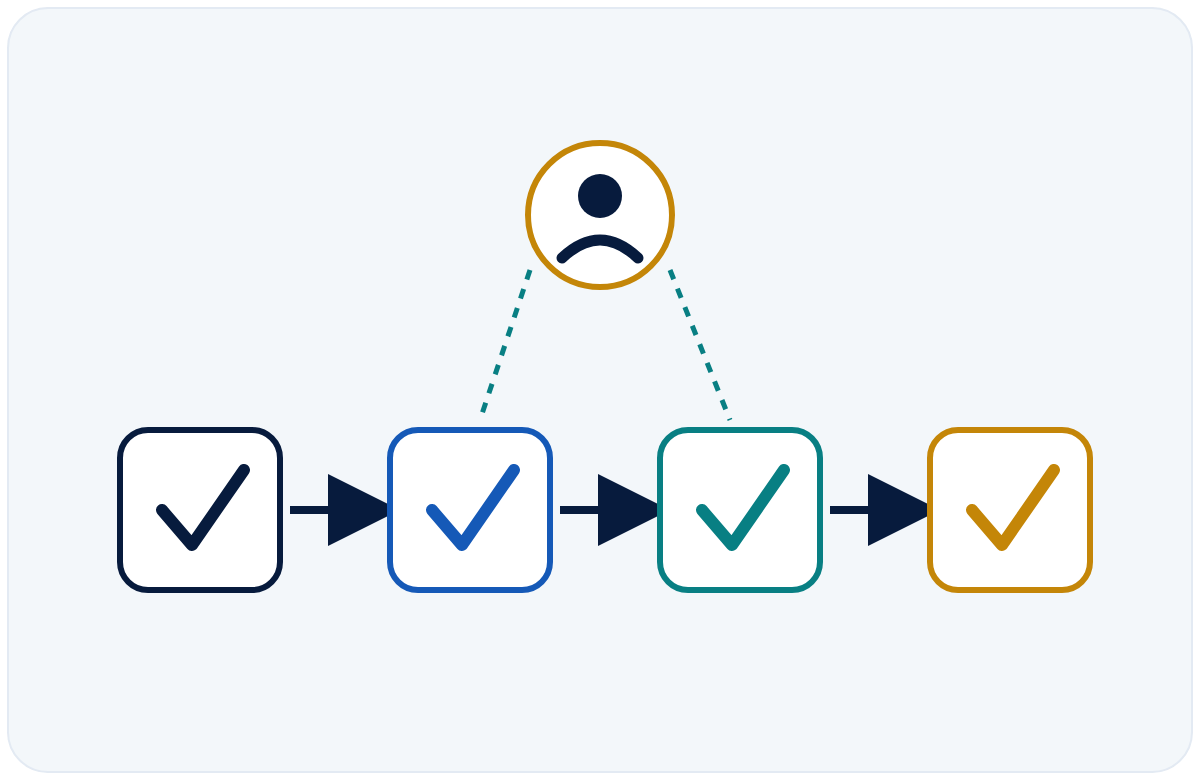
“Agentic AI” usually means giving one model broad powers and hoping it behaves: read anything, call any tool, plan freely. That can be impressive. It can also be unaccountable in precisely the situations where accountability matters most.
Culture is full of those situations. Museum collections with legal conditions. Community knowledge with custodians. Personal stories inside oral histories. For these, “the model decided to” is not an acceptable sentence.
Our approach, in four rules
One job per agent. The agent that finds sources never decides whether they may be used. The one that retrieves content never composes the answer. Institutions learned this separation of duties centuries ago; we simply apply it to software.
A fixed order of work. Finding, permission-checking, retrieving, cleaning, composing: always in that order, never improvised. Predictable systems can be audited. Surprising ones can only be forgiven.
Bounded freedom. Within its role, an agent has room to be genuinely useful. Beyond it, nothing. Every action needs a valid permission for a specific purpose, retries are capped, and when something can’t be resolved safely, the agent stops and says so.
People hold the difficult calls. Sensitive steps carry human review. Operators can pause everything. Communities decide whether AI touches their knowledge at all. And wherever AI has been involved, the result says so plainly.
Why bother
Because trust that depends on an AI being well-behaved isn’t trust. It’s luck. We’d rather build a structure where the shortcut simply cannot be expressed, and then invite people to inspect it.
You can read how this shapes each application across the platform, or see the whole approach in our AI governance pages.